Rob Horton
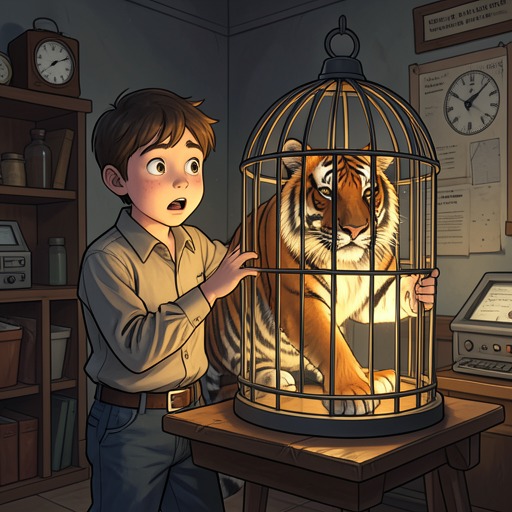
The Tiger RisingRob Horton is a boy whose discovery of a caged tiger interrupts a life organized around not feeling. After his mother’s death, he locks grief away as if it were too much to carry; the tiger becomes both a new focus for his attention and part of the loss he must eventually confront. Rob’s arc turns on the difference between containing pain and allowing it to be shared: when the tiger dies, his anger breaks through, and he and his father finally acknowledge their common grief.
Identity and Background
Six months after Rob and his father move from Jacksonville to Lister, Rob has not cried once. His emotional restraint is not a sign that he has stopped grieving: he has made a practice of pushing feelings out of awareness. His mother’s death, the funeral, and the move remain part of the pressure he is trying to contain, even as he avoids thinking about them directly.
Rob gives this strategy a concrete image. He imagines himself as a suitcase packed too full, like the one he packed when the family left Jacksonville after the funeral. He stuffs every feeling inside, sits on the case, and locks it shut. The metaphor describes both his effort and its fragility: the feelings strain to get out, and keeping them sealed takes continued work. His imagined suitcase makes an inward, largely invisible struggle legible without suggesting that the grief has disappeared.
The morning he discovers the tiger, Rob waits for the school bus beneath the Kentucky Star neon sign, whose yellow star rises and falls above blue neon shaped like Kentucky. He likes the sign and holds a dim but lasting hope that it will bring him luck. Earlier, wandering in the woods behind the Kentucky Star Motel, he had been hoping to get lost or be eaten by a bear so that he would not have to go to school. Instead, beside a boarded-up, deteriorating gas station, he finds a real tiger pacing in a cage. In the rain and ground fog, the animal seems to rise from the mist; Rob is astonished, afraid to look too long in case it disappears, and runs home with his heart insisting on what his mind doubts. On the bus, he is also anticipating Norton and Billy Threemonger, who wait to attack him. The tiger becomes something he can set above the packed case of feelings: vivid, strong, and seemingly untouched by what presses inside him.
The Tiger and the Turn Toward Connection
The tiger does not resolve Rob’s grief, but its arrival changes what he can attend to. As he waits beneath the sign in the first drops of rain, Rob imagines the animal sitting proudly on his suitcase, blinking its golden eyes. The picture joins two opposing conditions: the tiger is physically imprisoned, while Rob’s feelings are emotionally shut away; yet in his imagination the animal is powerful enough to bear the weight of what Rob refuses to think about. His encounter gives him an image for his inner life before he can speak openly about it.
Rob’s discovery also becomes an opening toward Sistine Bailey. After seeing her bleeding knuckles and fierce expression, and watching her look from the motel to the blinking sign and back as though trying to solve a problem, Rob feels something open inside him. He compares that sensation to picking up a piece of wood and working on it without knowing what it will become, then recognizing the result as it takes shape. He takes a breath and tells her, “I know where there’s a tiger.” The disclosure is a decisive act of connection: rather than keep the discovery to himself, Rob invites Sistine into the secret that has become central to his attention.
Care, Grief, and the Words He Inherits
Rob’s response to Sistine’s crying reveals a capacity for tenderness he has kept under restraint. At the tiger’s cage, Sistine shakes the enclosure and beats her head against the chain-link. When she gasps, Rob fears she may be choking; approaching her, he sees that she is crying. He stands beside her, terrified and amazed. Her distress recalls the care his mother once gave him when he still cried: she would cup the back of his neck and tell him, “You go on and cry. I got you. I got good hold of you.”
Before deciding whether reaching out is right or wrong, Rob puts his palm on Sistine’s neck. He feels her pulse beating in time with the tiger’s pacing and repeats his mother’s words: “I got you,” he tells her. “I got good hold of you.” The gesture is both physical reassurance and a transfer of remembered care. Rob cannot restore the person who comforted him, but he can offer another person the language and touch through which he was comforted. Sistine continues crying and does not ask him to remove his hand. By dusk, as they walk back toward the Kentucky Star, she has stopped crying but remains silent; their encounter does not settle what should happen to the tiger, but it establishes a moment of trust between them.
The Tiger’s Death and the Open Suitcase
When Rob’s father kills the tiger, Rob’s attachment to the animal and his stored grief erupt together. He accuses his father of killing his tiger, runs at him, and attacks him with his fists and feet. His father stands firm, holding the gun over his head and taking each blow without blinking. Rob recognizes that hitting cannot express what is underneath his rage. He does what he thought he would never do: he opens the suitcase. The words that come out are not restrained or orderly. He tells his father he wishes his father had died instead of his mother, says he hates him, and cries out that he needs her.
The outburst makes explicit the loss Rob had been locking away. His anger at his father is inseparable from his need for his mother, and the tiger’s death gives that buried need a sudden, undeniable occasion to surface. The suitcase image changes function: it had represented a defense against feeling, but opening it lets Rob speak the grief that the defense could no longer hold. His words are painful, yet they make a response possible. His father pulls him close and admits that he, too, needs her, while recognizing that neither can have her back and that they have each other.
Reconciliation and Narrative Significance
Rob initially insists that he will not cry, but tears come anyway, first leaking out and then arriving in a rush he cannot stop. He describes the crying as rising from deep inside, from the place where his mother had been and where the tiger had been before it was gone. The parallel does not make the two losses identical; it shows that the tiger’s death has entered the same emotional space Rob has kept closed since his mother died. His father wipes tears from his own eyes and holds him, telling him that he is all right. Their shared tears mark a change from a family rule of containing grief toward an acknowledgment that both father and son are suffering.
Rob’s significance lies in the movement from private containment to mutual care. The suitcase, the tiger, and the act of opening recur as connected images: Rob first uses the tiger to hold down what he cannot face, then loses the animal, and finally opens the case when suppression fails. His words to Sistine show that his mother’s tenderness has not vanished with her; it can be remembered and given onward. His reconciliation with his father, in turn, does not undo either death. It begins with the recognition that they share the loss and must learn to live with one another in its aftermath.